
 May 29,2026
RCT®️ (Rapid Color Technology) is an innovative digital printing platform independently developed by Zhengzhou HONGSAM Digital Science and Technology Co., Ltd. This technology using water-based functional inks, enables printing and coating to be completed at the same time. The technology deeply integrates the digital precision of inkjet printing with the exact control of chemical reactions, with its core concept being "rapid ink fixation and instant imaging."
Digital Controllable Chemical Reactions at Pixel Level
· Positional Control: Pixel-level precision
High-resolution print engines deliver pixel-accurate positioning. Compatible with mainstream industrial printheads from Epson, Ricoh, Kyocera, and Starfire, the technology ensures chemical reactions occur only at the intended pattern pixels.
· Concentration Control: Continuous grayscale adjustment
Grayscale printing technology allows ink deposition per pixel to be precisely controlled from a few picolitres to dozens of picolitres, creating smooth tonal transitions and accurate color reproduction through controlled reactant concentration gradients.
· Sequence Control: Programmable multi-path execution
Multi-channel printing architecture supports flexible reaction sequencing (e.g., A-to-B, B-to-A), enabling layered stacking of reactants at the same location to build three-dimensional chemical gradients. Various combinations such as A-B-C-D can be programmed as needed.
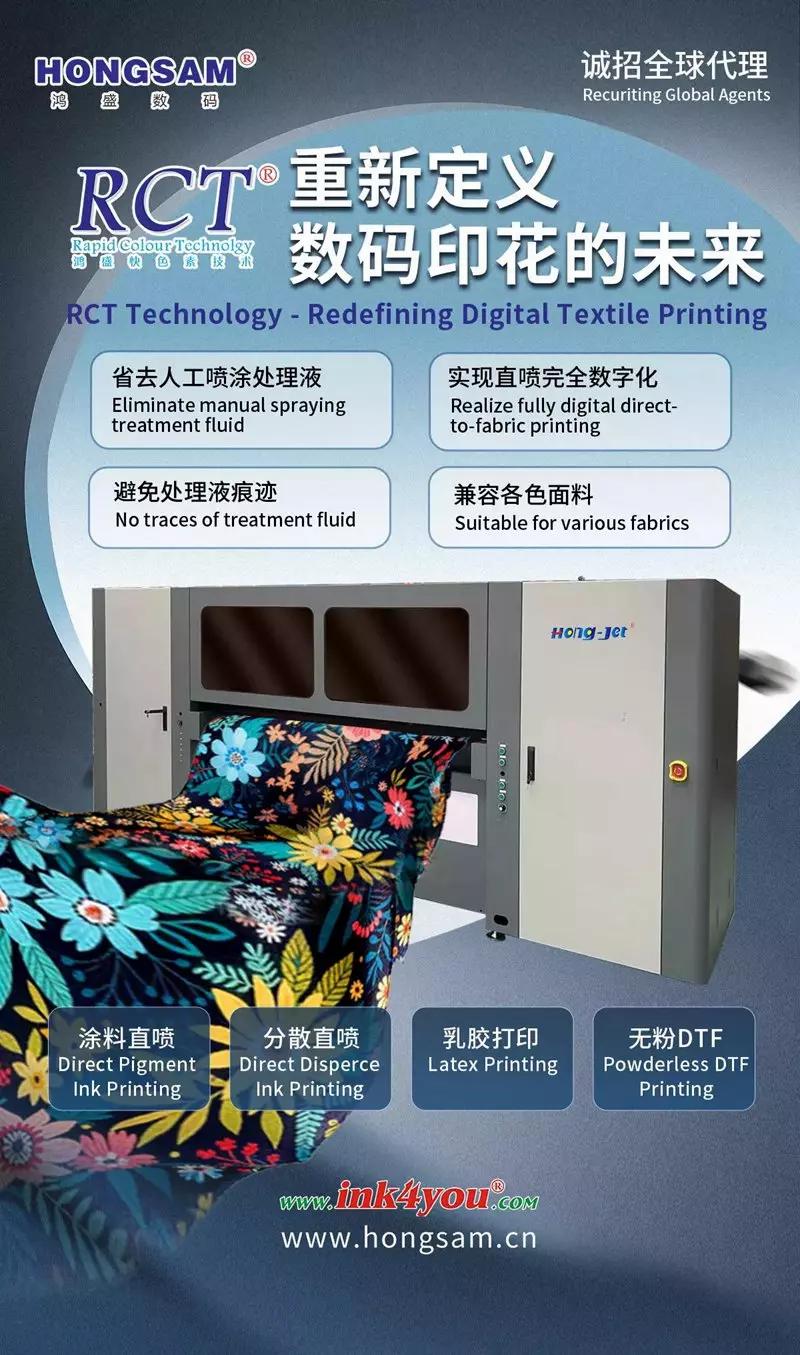
HONGSAM accumulated over a decade of inkjet technology expertise from 2006 to 2017 before commercially launching RCT®️ technology in 2017. The company now holds 19 invention patents (including 4 core JETEXTILE® patents) and multiple registered trademarks, covering printing solutions, compatible inks, and process control — forming a comprehensive technological advantage.
RCT®️ Technology Evolution Timeline:
· 2006–2017: Foundation-building phase focused on ink formulation and auxiliary development.
· 2017: Official launch and validation of digitally controllable chemical reactions.
· 2018–2022: Expanded solutions for pigment and disperse direct-to-fabric challenges.
· 2023–present: The JETALL® latex ink reached maturity, achieving room-temperature printing on non-absorbent materials. It was included in the China Dyeing and Printing Industry Association’s energy-saving and emission-reduction recommendation list. JETALL® latex ink enables low-energy, room-temperature printing on heat-sensitive materials, meeting stringent requirements for high abrasion resistance and flex durability in athletic footwear and sportswear while delivering truly odorless, healthy, and eco-friendly solutions.
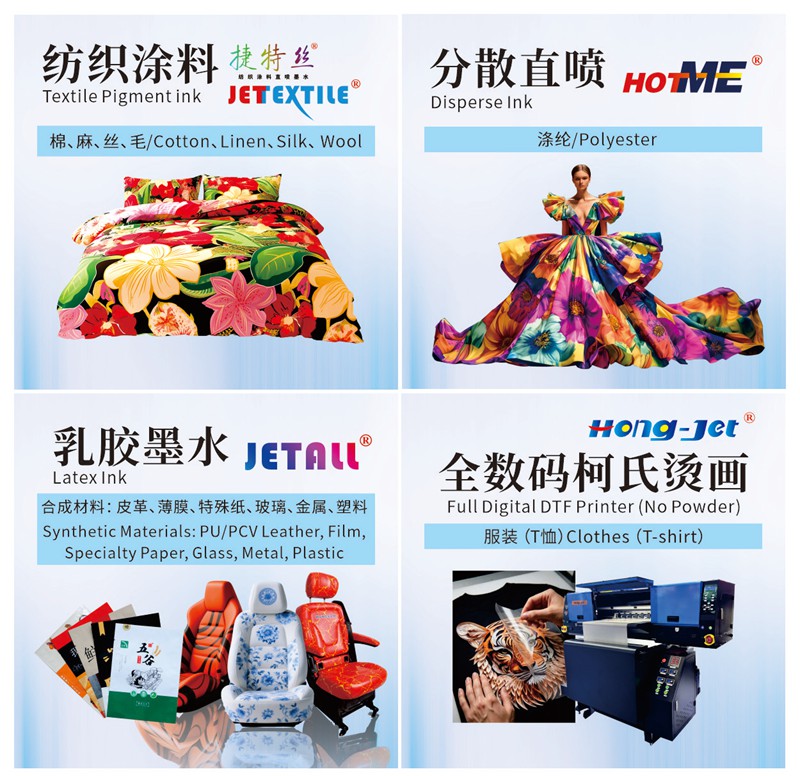
The RCT® technology has developed four specialized product lines that cover everything from natural fibers to synthetic materials:
· JETEXTILE® Textile Pigment Ink: For natural fibers
Water-based pigment ink printing solution designed for cotton, linen, silk, wool, and similar materials, uses nano pigment dispersions combined with RCT®️ reactive binders, mainly used in apparel and home textiles.
· HOTME® Disperse Ink: Breakthrough for polyester
High-sublimation-fastness disperse dye system with RCT®️ penetration control for polyester and blended fabrics. Successfully realize the trade-off of “high fastness vs. high penetration vs. high definition”.
· JETALL® Latex Ink: Pioneer for synthetic materials
Water-based latex polymer system that cures at room temperature is ideal for PU, PVC, and microfiber synthetic leathers used in footwear and automotive interiors. Water-based latex ink enables room-temperature digital printing on multiple non-absorbent substrates.
· Full Digital DTF Printing Solution (No Powder Needed): environmental upgrade of traditional DTF printing
It’s suitable for transfer printing on transfer film and various fabrics. Self-crosslinking adhesive resin eliminates the need for hot-melt powder, supporting personalized customization and small-batch production.
RCT®️ integrates traditional pretreatment directly into the printing workflow:
· Selective Deposition and Printing: Pretreatment liquid are applied only to areas that will be printed, dramatically reducing chemical usage and eliminating waste.
· Dynamic Dose Control: Real time adjusted coating volume based on pattern density for optimal performance with minimal chemistry.
· Non-absorbent Substrate Printing: For non-absorbent substrates such as glass, metal, and plastic, RCT®️'s in-line digital coating technology enables direct printing without the need for primer. The primer ink forms a functional coating in situ, significantly expanding the application boundaries.
1. Dramatic Production Cycle Reduction (Over 70%)
Traditional reactive dye printing requires 7–9 steps (pasting, printing, drying, steaming, washing, soaping, drying), taking over 24 hours and generating heavy wastewater.
RCT®️ pigment ink direct printing reduces this to just 3 core steps: in-line digital coating, printing, and 5–8 minutes of heat curing. Compared to traditional reactive ink printing, it saves on processing steps and costs, and generates no wastewater.
RCT®️ disperse ink direct printing has 3-4 efficient processes. Online coating, digital direct printing, dry and color development takes 8-15 minutes, in-line post-treatment is optional, and the total cycle is less than 3 hours.
Real Case Study: A major Vietnamese garment manufacturer reduced production lead time from 7 days to within 24 hours using the JETEXTILE® pigment ink printing system, significantly lowering inventory costs and meeting fast-response and sustainability demands from European and American brands.
2. Superior Color Vibrancy and Print Clarity
a. Enhanced color vividness and saturation
Optimization of the chemical reaction mechanism results in a more uniform and dense distribution of chromophores, allowing the dispersed direct-jet dye to fully penetrate into the amorphous region of the fiber for in vivo coloring. The application of crosslinking curing in the coating process leads to tight packing of pigments, enhancing color intensity.
b. The printing accuracy maintains clarity without smudging
High migration fastness dyes quickly anchor and maintain the clarity of pattern boundaries, ensuring fine details are preserved even in high-permeability scenarios, without compromising on clarity due to permeation.
c. Software-defined penetration: digital controllable adjustment
By adjusting the parameters such as pass times, ink volume, and baking conditions through software, continuous adjustment of penetration depth can be achieved within the same ink system. For shallow penetration, reduce the ink volume and lower the temperature; for deep penetration, increase the ink volume and optimize the conditions, laying the foundation for future intelligent printing.
3. Comprehensive Fastness Breakthrough
· Exceptionally High Sublimation Fastness, Zero Risk of Color Migration: Instant fixation technology virtually eliminates color bleeding during drying. Disperse inks are designed to penetrate to an appropriate depth, ensuring intimate contact between the dyes and the fibers, resulting in uniform and thorough color development while minimizing surface floating color.
· Image-Level On-Demand Processing
On-demand targeted treatment avoids issues like white-ground staining, yellowing, and ghosting.
· Zero Migration, High Fastness
Ensuring zero migration or bleeding during the coloration process, the strong intermolecular interactions between pigment and dye molecules and the fibers reinforce the design integrity. Reactive auxiliaries provide an anchoring effect that rapidly fixes the pigments and dyes in place, maintaining precise pattern definition even under conditions of deep penetration. This achieves a harmonious balance of high fastness, deep penetration, and high clarity.
· Over 70% Water Savings, Over 50% Energy Savings: A Water-Free Evolution of Eco-Friendly Digital Textile Printing Solutions
4. Environmental Performance
· Water consumption reduced by over 70%, energy consumption reduced by over 50%, production cycles shortened by over 70%—streamlined processes drive enhanced efficiency.
· VOC Reduction and Waterless Processes
Water-based formulations eliminate organic solvents, resulting in zero wastewater discharge. RCT process virtually eliminates wet processing steps.
· Water-based formulations with OEKO-TEX Eco Passport, REACH compliance, and GOTS compatibility. Multiple products have been listed in China’s national energy-saving and emission-reduction catalogs.
1. Pigment Ink Direct Printing on Cotton: A New Eco-Friendly Standard
Advanced reactive binders create strong chemical bonds between pigments and cotton fibers, enabling a steam- and wash-free process. Water consumption has been reduced by over 70%, energy consumption has been reduced by over 50%, cycle compression has been improved by over 70%, and the fastness to sunlight has reached level 6-7. Reduce the usage of adhesive, adopt softer reactive polymers, and achieve high saturation and high contrast color output through fine adjustment of ink volume and reaction conditions.
Addressing the long-standing challenge of balancing color and texture in pigment printing, and expanding its application to branded fashion (high-end clothing with stringent requirements for both color and texture) and fine home textiles (bedding, curtains, and other areas with high requirements for tactile feel and color fastness), significantly broadening the application boundaries of pigment printing and entering the high-end market previously dominated by dye printing.
2. Disperse ink Direct Printing on Polyester: Solving Uncontrollable Penetration
Swimwear and tight sportswear widely adopt high-elastic fabrics blended with polyester and spandex. Traditional sublimation transfer printing dyes only adhere to the surface of the fibers, revealing white yarn after stretching, which is particularly prominent in the European and American markets.
RCT®️’s high-penetration reactive system drives dye deep into the fabric, creating true double-sided coloration, even on stretchy polyester/spandex blends. Digital control of ink volume and grayscale enables consistent penetration on challenging pile fabrics.
3. Non-absorbent Materials Printing: A New Era of Green Printing on Synthetics
JETALL®️ latex ink achieves water-based digital direct printing on PU/PVC/microfiber leather. After printing with latex particles, they undergo crosslinking to form an elastic film layer, preserving the soft feel and bending performance of the material. This technology fills a significant gap in the field of sustainable digital printing for non-absorbent materials. JETALL®️ latex ink printing solution has been applied in eco-friendly and odorless printing for brands such as Anta Sports, BYD automotive interiors, and IKEA.
In addition, JETALL® latex ink printing solution enables direct water-based printing on rigid substrates. In-line digital coating allows direct printing on rigid substrates such as glass, metal, and plastic without the need for primer, with real-time adjustable coating thickness, breaking through the bottleneck of pre-treatment for non-absorbent materials.
|
Comparison of JETALL® Water-Based Latex Ink Printing Solution and Traditional Solutions |
|
|
Solution |
Feature |
|
JETALL® Latex Ink Printing Solution |
Uses water as the dispersion medium; Very low VOC emissions, excellent flexibility. |
|
Solvent Ink |
Uses organic solvents; High VOC emissions. |
|
UV-Curing Ink |
Poor ink flexibility, prone to cracking; short in both environmental and physical performance. |
4. Powderless DTF Solution and Cross-Media Applications
Traditional DTF printing requires powder shaking that leads to dust pollution. The RCT®️ powder-free DTF printing solution, through innovative ink formula, endows patterns with inherent transfer and bonding capabilities, achieving a streamlined process of printing-transferring-finishing, thereby eliminating microplastic pollution of TPU hot melt adhesive powder from the source. Furthermore, this technology is adaptable to complex pore structures, enabling effective coloring and fixation, and has been extended to industrial material fields such as filter materials, geotextiles, and medical nonwoven textiles.
The global digital textile printing market was valued at $25.8 billion in 2024 and is projected to reach $56.7 billion by 2033 (CAGR 9.3%). HONGSAM focuses on two major technology gaps: high-quality direct printing across all fiber types with controllable penetration and high fastness, and environmentally-friendly printing on non-absorbent materials (PU leather). The company is particularly strong in challenging areas such as blended fabrics, polyester, and synthetic leather. Enhancing the penetration of digital printing technology in the pan-printing and dyeing field.
As the inventor of RCT®️ pre- and post-treatment-free digital printing technology, RCT®️ technology represents not only an innovation in printing technology but also a pivotal driving force for the transformation of textile manufacturing towards green, intelligent, and service-oriented industries, leading the industry to embrace a new era of green intelligence. HONGSAM has participated in the formulation of multiple national and industry standards, promoting the green transformation of the industry from the perspective of product standards.
VIII. Driving Industrial Upgrades: From Ink Sales to Technology Service Ecosystem
Under the “HONGSAM+” philosophy, HONGSAM builds a complete ecosystem centered on ink but encompassing formulation, process development, and application support. This creates a collaborative network of ink suppliers, equipment manufacturers, end users, and software developers. The more participants there are, the greater the ecological value becomes, promoting the formation of industry standards and best practices.
By shifting from single-product sales to full-life cycle service, HONGSAM strengthens customer relationships and accelerates the industry’s evolution from manufacturing-driven to service-driven, enhancing the global competitiveness of China’s digital textile printing sector. Consequently, achieving the dual goals of business model evolution and industrial upgrading.
Consult


+86 19036977269
+86 19036977269