
 Nov 17,2026
Carpets have a history spanning several thousand years and carry the imprint of human civilization. Early nomadic peoples living in high-latitude regions ingeniously wove animal hides and fur to protect themselves from biting cold winds and damp ground, laying these coverings on the floors of their dwellings. This was the earliest form of the carpet. As eras changed, regional cultures intermingled, and user needs diversified, carpets evolved far beyond a simple decorative floor covering. They acquired richer practical functions and deeper symbolic meaning.
Today’s modern carpets serve not only as decorative highlights in residential and commercial spaces but also provide multiple practical benefits: environmental beautification, sound absorption and noise reduction, anti-slip and shock-absorbing performance, and value as craft collectibles. They have become an indispensable element of everyday life.
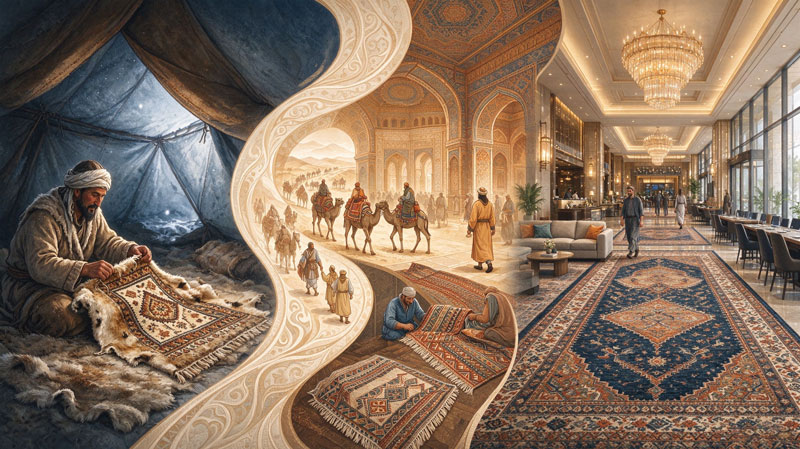
The evolution of carpet materials has always been driven by practicality and availability. Early carpets were limited to scarce animal hides and fur. Obtaining the raw material was difficult; incomplete removal of natural oils produced unpleasant odors, and the material was prone to rotting and insect infestation, severely affecting the user experience. Later, as cotton cultivation spread, the excellent thermal properties of cotton became widely recognized. People began weaving carpets from cotton, expanding the range of applications.
In the 19th century the rise of the petroleum industry gave birth to synthetic fibers and opened a new chapter for the carpet industry. From the 20th century onward, the variety of synthetic fibers grew rapidly. Their successive adoption in carpet production greatly broadened product choices and delivered qualitative leaps in abrasion resistance, water resistance, and ease of cleaning, laying a solid foundation for industrial-scale production and widespread use.
Machine-made carpets encompass several categories, including woven carpets (Axminster and Wilton), tufted carpets, modular (tile) carpets, and needle-punched carpets. With the Industrial Revolution, the limited output of hand-made carpets could no longer meet rising demand. Machine-made carpets emerged, using industrial production methods to raise efficiency dramatically. Carpets shifted from handmade luxury items to industrialized floor coverings and found wide application in commercial spaces and ordinary homes, satisfying the need for large-scale supply.
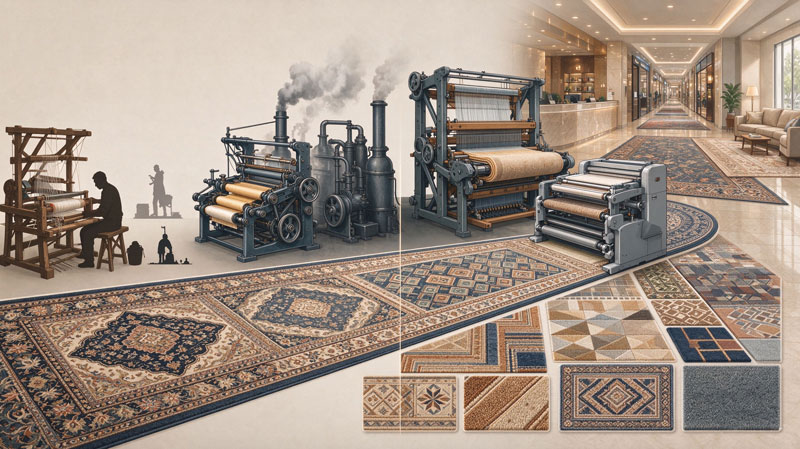
As machine-made carpets became widespread, demand for carpet printing surged and printing technology advanced through successive generations. Carpet printing has progressed through four main stages: gravure printing, flat-screen and rotary-screen printing, digital jet-printing (spray), and digital inkjet printing. Gravure and screen printing have largely been phased out because of technical limitations. Today the mainstream processes are digital jet-printing and digital inkjet printing.
The process begins with color separation of the design, followed by preparation of the corresponding pastes. A digital control system then operates solenoid valves to spray the pastes precisely onto the carpet substrate. Subsequent steps include high-temperature fixation, washing, and drying to produce the finished printed carpet. The advantages are bright, vivid colors and good penetration that carries color deep into the fibers. The drawbacks are equally clear: the process is limited by the number of color stations, paste must be prepared in advance (leading to waste), and thorough washing is required after fixation to remove residual paste and surface dye. This generates large volumes of industrial wastewater, significantly raising treatment costs and overall production expense.
Using advanced digital technology, high-precision print heads deposit specialized inks directly onto the carpet substrate. High-temperature fixation, optional light washing, and drying complete the process. Unlike jet-printing, inkjet requires no advance paste preparation. Printed carpets can be finished with a wash-free or minimal-wash process according to need. This sharply reduces wastewater volume, eases the burden and cost of treatment for manufacturers, and aligns far better with modern environmental standards.
Any discussion of the development of carpet digital printing must mention the Austrian company Zimmer. Zimmer’s invention of digital jet-printing technology for carpets greatly accelerated the industry’s transition from traditional rotary-screen printing to digital production. Through deep specialization in carpet digital printing, the company has built an exceptionally strong and focused position, particularly in the high-end commercial segment. For manufacturers seeking the most durable carpets with the strongest color coverage, Zimmer equipment is usually the first choice. In the field of carpet digital printing, Zimmer’s technical contribution and market standing are foundational and pivotal.
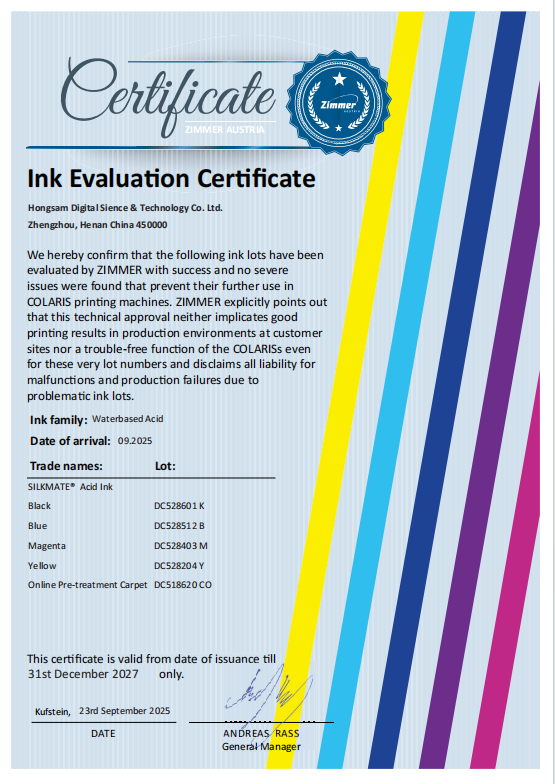
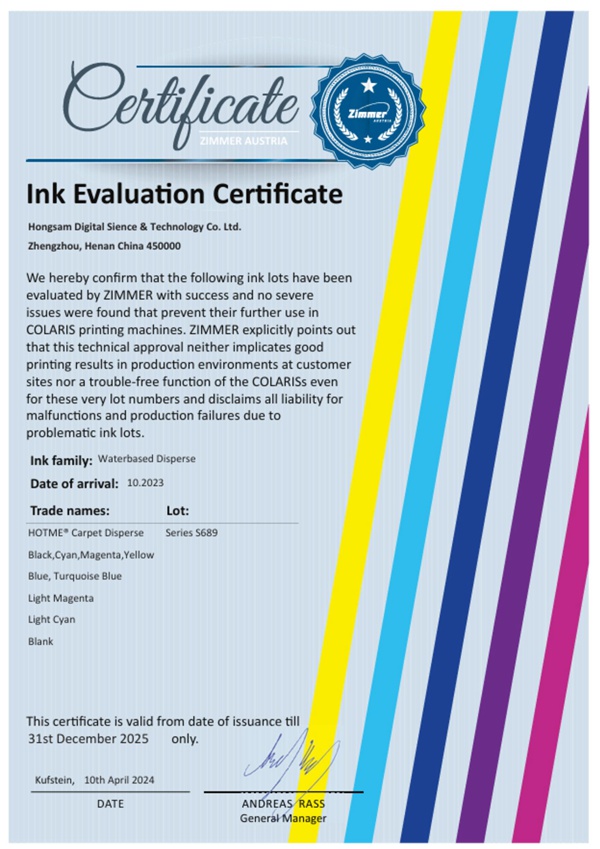
As a European equipment manufacturer, Zimmer initially preferred European ink brands. In the Chinese market, however, HONGSAM was the earliest domestic ink producer to cooperate with Zimmer. After years of research, development, and quality refinement, HONGSAM’s acid inks, disperse inks, and pigment inks have all obtained official Zimmer certification, giving Chinese-made inks a recognized place in the international high-end market.
Comparison of Digital Jet-Printing and Digital Inkjet Printing
|
Comparison Dimension |
Digital Jet-Printing (Spray) |
Digital Inkjet Printing |
Analysis Summary |
|
Carpet Weight |
Broad adaptability; especially strong for high-weight, long-pile, high-density carpets |
Certain limitations; greater challenges in penetration and pattern clarity on extremely high-weight, long-pile carpets |
Jet-printing uses a large volume of paste, enabling thorough penetration to the carpet base and suiting high-weight products. Inkjet uses relatively less ink and struggles to fully penetrate deep fibers of high-weight carpets. |
|
Printing Effect |
Unrestricted pigment loading; pure color and high saturation, though pattern fineness is somewhat limited |
Mature advanced ink technology; high color saturation with wider color gamut and finer, more natural gradients |
Inkjet offers richer color expression and higher pattern definition, with a clear advantage in photo-realistic high-definition images. |
|
Color Penetration |
Excellent penetration; paste fully wets and reaches the base of the pile for through-color dyeing, delivering outstanding abrasion fastness |
Moderate penetration; prone to 'ring dyeing' where dye covers only the surface of the pile without reaching the fiber interior |
Penetration is the core strength of jet-printing. On high-weight carpets it avoids white exposure when the pile is bent. Inkjet penetration is weaker and more prone to white exposure, though this can usually be controlled and improved through process optimization. |
|
Order Volume Suitability |
Well suited to medium- and large-volume production; changing designs requires more complex machine cleaning and preparation than inkjet |
Extreme flexibility; ideal for small-batch and personalized custom orders. Design changes require almost no downtime and switching is highly efficient |
Inkjet is the ultimate solution for rapid response and personalized customization. Jet-printing retains advantages over traditional methods for large economical runs but remains less flexible than inkjet. |
|
Labor Cost |
Longer process chain with many steps; higher reliance on manual operation and correspondingly higher labor cost |
Highly automated process; far fewer production steps from printing to finished product and lower labor requirement |
The automated, simplified workflow of inkjet delivers a clear labor-cost advantage and aligns with industrial trends toward cost reduction and efficiency. |
|
Consumable Cost |
Relatively low cost of paste and thickeners; advantageous in material expenditure |
Highly competitive for products of 600 g/m² and below; for products above 600 g/m², consumable cost is slightly higher than jet-printing |
Cost advantage varies with product weight. Companies can select the process that best matches their product positioning. |
|
Wastewater Treatment Cost |
Washing is essential and generates large volumes of industrial wastewater containing unfixed dyes, thickeners and auxiliaries. Requires large professional treatment facilities with high operating and maintenance costs |
Extremely low or near-zero wastewater cost. Wash-free processes produce almost no effluent; even light washing generates far less wastewater that is easier and cheaper to treat |
This is the core environmental advantage of inkjet. High wastewater costs are a major drawback of jet-printing, making project approval especially difficult in regions with strict environmental regulations. |
|
Process Complexity |
Relatively complex; long production chain with many stages requiring careful process control |
Relatively simple; short production chain with streamlined steps and easier process control |
The simplicity of inkjet brings combined gains in production efficiency, energy control and product consistency, making it better suited to modern large-scale manufacturing. |
The multi-dimensional comparison shows that digital jet-printing and digital inkjet printing will continue to coexist and complement each other for some time. However, as global environmental requirements tighten and the principle of sustainable development takes deeper root, carpet digital inkjet printing—with its wash-free capability and superior environmental performance—will, by virtue of its combined advantages in environmental protection, cost control, and flexibility, become the dominant direction of carpet printing in the future.
Carpet digital inkjet printing is divided into three principal process types according to yarn material: nylon acid digital printing, polyester disperse digital printing, and acrylic / cationic-modified polyester cationic ink digital printing. Each is matched to the production requirements of different carpet materials.
1) Nylon Acid Ink Digital Printing
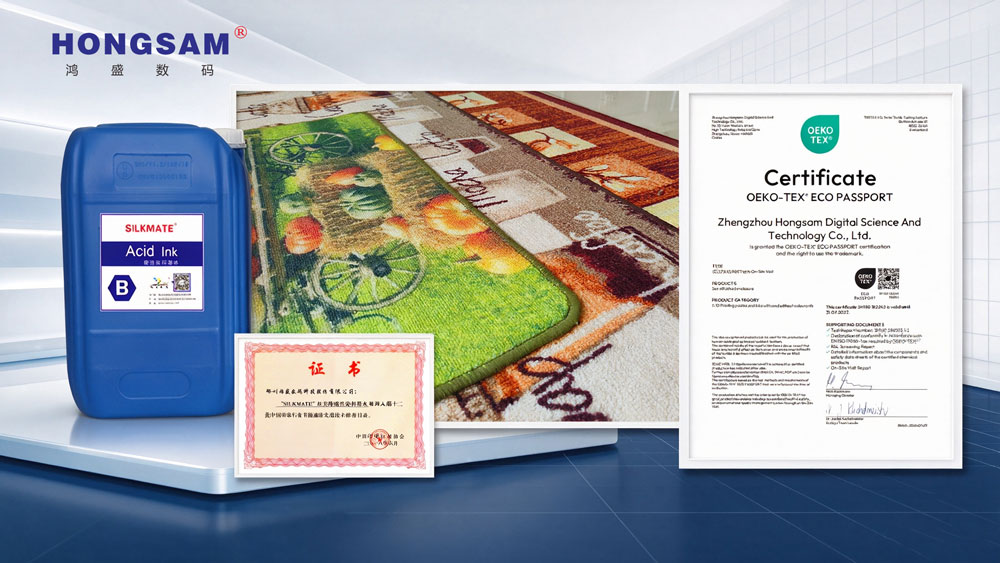
Nylon (PA, polyamide) yarn offers high strength, excellent abrasion resistance, soft bulk, fire retardancy, and anti-static properties, making it one of the most suitable materials for carpets. In the commercial carpet sector, nylon is especially favored.
Process flow for nylon acid carpet printing: blank carpet preparation → carpet pre-wetting → digital inkjet printing → steam fixation (spray fixing agent) → (light washing) → drying → weft straightening → finished product.
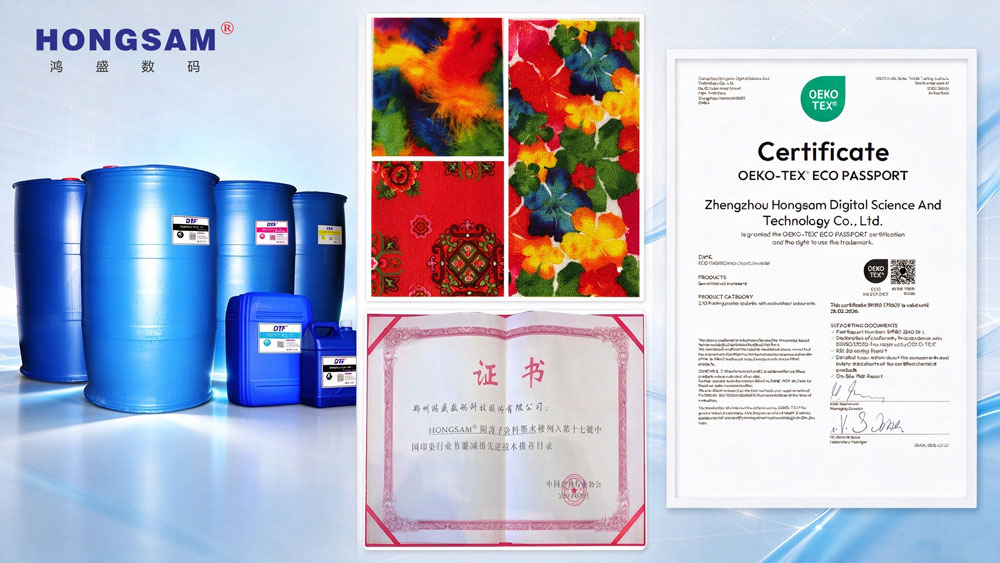
HONGSAM has specialized in carpet digital inkjet printing for many years and has a clear understanding of the industry’s production pain points and requirements. By selecting high-quality dyes and continuously optimizing ink formulations, the company has developed dedicated acid dye inks for carpet digital inkjet printing. These inks deliver bright, full colors and good penetration, together with extremely high dye fixation rates that make true wash-free production possible in most cases. This greatly reduces industrial wastewater and improves manufacturers’ economic results. For customers with special requirements for light-fastness, HONGSAM has introduced high-light-fastness acid dye inks HC and HM. Compared with standard acid dye inks, these raise light-fastness by 0.5–1 grade, better meeting the needs of outdoor or strong-light environments. HONGSAM’s carpet acid dye inks have also obtained OEKO-TEX ECO PASSPORT ZDHC Level 3 certification, providing strong support for export of finished carpets. The SILKMATE® acid dye ink was selected in " the 12th Batch of Advanced Technology Recommendations for Energy Saving and Emission Reduction by China Dyeing and Printing Association", receiving high recognition from the industry.
2) Polyester Disperse Ink Digital Printing
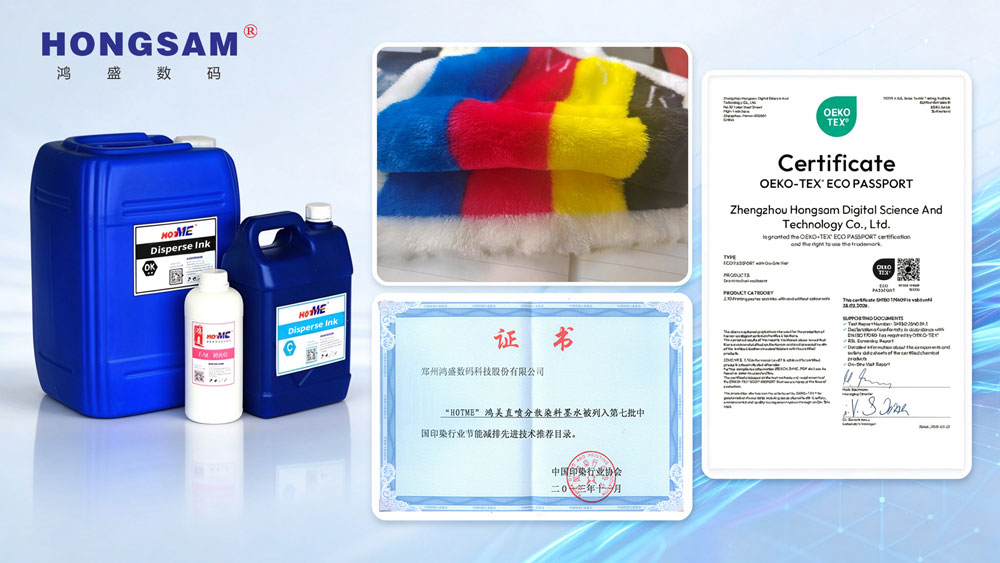
Polyester (PE fiber) has become widely used in the carpet industry following advances in BCF technology. It offers high strength and abrasion resistance comparable to nylon. Combined with the growing availability of recycled polyester fiber, it significantly lowers production costs and has become a highly cost-effective market choice.
Process flow for polyester disperse digital printing: blank carpet preparation → carpet pre-wetting → digital inkjet printing → high-temperature fixation → (light washing) → drying → weft straightening → finished product.
Polyester fiber can only be dyed with disperse dyes. Because carpet production lines are typically continuous from blank carpet to finished printed product, the process involves many stages and specialized equipment. Site constraints and the characteristics of the carpet substrate can result in incomplete dye fixation, leaving some disperse dye on the surface and compromising color fastness, abrasion resistance, and other key performance indicators. Addressing this industry pain point, HONGSAM selects high-fixation-rate disperse dyes for its inkjet inks and pairs them with proprietary functional inks. Without the need for washing, the company has substantially raised all fastness indicators of disperse dyes on polyester carpets, ensuring product quality while reducing wastewater pressure on manufacturers. As early as 2013, HONGSAM HOTME® direct-to-fabric disperse dye ink was selected in " the 7th Batch of Advanced Technology Recommendations for Energy Saving and Emission Reduction by China Dyeing and Printing Association", underscoring its leading position in technology development and environmental responsibility.
3) Cationic Ink Digital Printing
Acrylic yarn is known for its bulk and softness; carpets made from it offer warmth comparable to wool and are therefore sometimes called “artificial wool.” Wool carpets are typically used as high-end residential products—famous Persian carpets are predominantly wool. Because raw wool is expensive and beyond the reach of ordinary consumers, acrylic fiber filled this market gap, enabling acrylic carpets to partially substitute for wool and enter more households.
Ordinary polyester yarn has limited bulk and softness. Advances in synthetic-fiber technology led to cationic modification of polyester, producing cationic-modified polyester fiber. Compared with standard polyester, the modified fiber shows significantly improved bulk and elasticity and superior overall quality.
Cationic dyes are dyes that ionize in aqueous solution to form positively charged color cations. They play an irreplaceable role in dyeing acrylic and are therefore known as acrylic-specific dyes. They offer excellent color performance, outstanding light-fastness, and rapid fixation. Cationic-modified polyester has a lower glass-transition temperature, rendering traditional disperse dyes unsuitable; cationic dyes, with their ability to dye at lower temperatures, become the preferred choice.
Process flow for cationic dyeing: blank carpet preparation → carpet pre-wetting → digital inkjet printing → steam fixation (spray fixing agent) → (light washing) → drying → weft straightening → finished product.
Because cationic dyes carry a positive charge in aqueous solution, they readily react with printhead components, posing a major challenge to printhead safety when formulating inkjet inks. At present, cationic processes still account for a large share of carpet digital jet-printing, while their share in digital inkjet printing remains relatively small because of the difficulty and slower progress of cationic inkjet ink development. HONGSAM identified this market need and technology gap as early as 2017, launched R&D on cationic inkjet inks, filed the relevant patent application in 2018, and obtained patent authorization in 2021. HONGSAM cationic dye ink is the only water-based cationic dye inkjet ink in China, filling a domestic technology gap. It was selected in " the 17th Batch of Advanced Technology Recommendations for Energy Saving and Emission Reduction by China Dyeing and Printing Association" in 2024, providing strong support for technological upgrading in the industry.
From the perspective of current market structure, the overall carpet industry has considerable capacity and demand remains stable. Printed carpets, however, still account for only a small share of the total—approximately 25 percent. Most carpets on the market continue to be yarn-dyed or jacquard. As digital printing technology for carpets becomes more widespread and mature, and as consumer demand for personalized and customized products grows, the market share of printed carpets is expected to rise gradually, offering substantial potential.
Globally, carpet consumption is concentrated in Europe, North America, the Middle East, and the Asia-Pacific region. In Europe and North America, consumption centers on mid- to high-end products, with buyers placing greater emphasis on quality, design, and environmental performance. Emerging markets in the Asia-Pacific region still focus mainly on mid- to low-end products, where price exerts a stronger influence on purchasing decisions. In Europe, North America, and the Middle East, religious and lifestyle traditions support widespread carpet use, predominantly in residential settings. In China, carpet consumption is concentrated in commercial and residential sectors (hotels, office buildings, shopping centers) and entertainment venues (cinemas, KTVs, gyms, billiard halls, etc.). Although the domestic real-estate market has been subdued in recent years, tourism continues to grow and the number of new entertainment venues keeps rising. This trend has directly expanded demand for carpet products in these sectors and injected new momentum into the industry.
On the policy front, China’s environmental regulations have tightened steadily in recent years. In northern regions, high-pollution weather triggers government orders for production stoppages, severely affecting normal operations and economic results. For carpet manufacturers, high-pollution, high-energy projects face increasing difficulty in obtaining environmental approval, and their living space continues to shrink. In contrast, wash-free carpet digital inkjet printing projects, with their outstanding environmental performance and alignment with national sustainable-development strategy, are expected to receive further policy support. Under this industry trend, more and more carpet producers are expected to transform voluntarily or to launch new digital inkjet printing projects in order to meet policy requirements and market changes.
Looking ahead, for carpet manufacturers the adoption of digital printing technology is no longer merely a matter of following industry fashion; it is an inevitable choice for building core competitiveness oriented toward the future. For consumers and designers, the development of digital printing will break the constraints of traditional production models and usher in an era of unprecedented choice in printed carpets, perfectly uniting personalized design with high-quality experience.
Consult


+86 19036977269
+86 19036977269